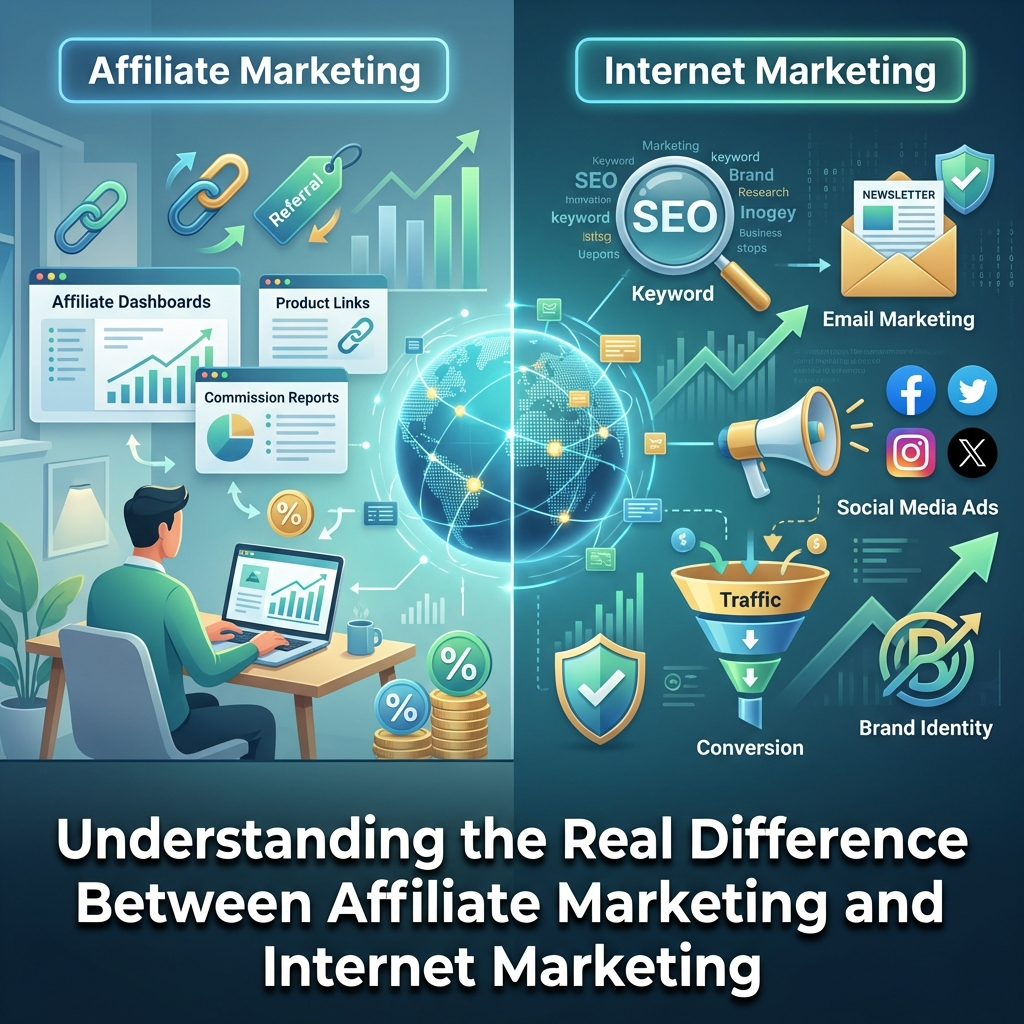
In the evolving landscape of online business, two phrases are often used interchangeably — affiliate marketing and internet marketing. Yet, they represent fundamentally distinct strategies with their own goals, tools, and mindsets. Grasping the nuances between them can define whether your digital strategy merely treads water or moves with precision toward long-term profitability.
Let’s cut through the jargon, dissect their differences, and explore how both disciplines can complement each other when strategized the right way.
The Foundation: What They Really Mean
What Is Affiliate Marketing?
Affiliate marketing is a performance-driven model in which an individual (the affiliate) promotes products or services of another company (the merchant) and earns a commission for each sale or lead generated. The affiliate acts as a bridge — connecting a potential customer to a product through blogs, social media, email campaigns, or videos — and gets compensated only when results are delivered.
Think of it as digital word-of-mouth, reinforced by tracking links and performance analytics. Affiliates don’t have to build or own the product; their strength lies in persuasion, positioning, and audience trust.
What Is Internet Marketing?
Internet marketing is the broader discipline that encompasses every marketing activity conducted online. It includes search engine optimization, paid ads, social media campaigns, email automation, and yes — affiliate marketing itself can be a component. The ultimate goal is to attract, convert, and retain customers in the digital space using multiple integrated strategies.
If affiliate marketing is a single gear, internet marketing is the entire machine. While one focuses narrowly on promoting specific products for commission, the other oversees brand building, audience growth, and multi-channel engagement.
The Core Differences
| Aspect | Affiliate Marketing | Internet Marketing |
|---|---|---|
| Objective | Driving sales or leads for another company | Promoting and growing your own brand, product, or service |
| Ownership | You market someone else’s product | You control the product, message, and long-term strategy |
| Revenue Model | Commission-based | Profit-based from your own offerings |
| Investment | Low — typically cost-effective startup | Higher — involves ad spend, content creation, and branding |
| Control Over Customer Data | Merchant owns the data | You own the customer relationship and analytics |
| Risk Level | Relatively low | Higher — but with greater reward and equity |
While both operate online, their financial and strategic DNA diverges. Affiliate marketing rewards influence and smart positioning. Internet marketing rewards vision and consistency.
The Skill Sets Required
For Affiliate Marketers
- Ability to identify resonant products and niches.
- Understanding of SEO-focused and conversion-driven content creation.
- Insights into audience behavior to ensure genuine recommendations.
- Data tracking and campaign analysis using tools like Google Analytics or affiliate dashboards.
For Internet Marketers
- Broader command of digital disciplines such as PPC, funnel engineering, CRM tools, and automation.
- Skill in cultivating a brand voice across multiple platforms.
- Long-term strategic thinking focusing on customer acquisition and retention.
Affiliate marketing demands finesse in storytelling and persuasion; internet marketing demands strategy orchestration.
The Interplay Between the Two
It’s a mistake to think that choosing one excludes the other. In reality, these two often feed each other in a symbiotic loop. Many businesses use affiliate marketing as a component of their larger internet marketing plan to harness influencers and niche publishers.
On the flip side, savvy affiliates often evolve into full-spectrum digital marketers. They start by promoting other brands, learn traffic generation, master funnel creation, and eventually launch their own products. Those who navigate both worlds fluently gain an advantage: flexibility, creativity, and scalability.
Misconceptions That Often Blur the Line
“Affiliate marketing is passive income.”
While it can generate sustained revenue, it’s far from hands-off. Producing credible content and optimizing campaigns demand ongoing attention.“Internet marketing is only for big brands.”
Small businesses and solopreneurs increasingly rely on internet marketing tools — from SEO to social storytelling — to build influence and compete with larger players.“Affiliate marketing requires no skill.”
In 2025, competition and algorithm changes have raised the stakes. Success relies on precision targeting, authentic content, and a data-backed strategy.
Choosing the Right Path
Your choice between affiliate marketing and internet marketing depends on your goals and resources.
- If you’re beginning and want to learn digital marketing fundamentals without the overhead of product management, affiliate marketing is ideal.
- If you have a brand or product of your own — or aspire to build one — focusing on broader internet marketing will yield more control and long-term equity.
Both paths intersect at one key lesson: an understanding of human behavior. Whether you promote your own product or someone else’s, the core strategy is empathy combined with analytics.
The Future of Both Fields
Technology now redefines how these strategies interact. AI-driven ad placements, personalized product links, and automation tools make affiliate marketing more precise. Simultaneously, new data privacy regulations push internet marketing toward greater transparency and value-driven engagement.
These trends converge on one truth: trust has become the most critical currency online. The marketer who communicates authentically — regardless of the channel — wins.
Final Thoughts
Understanding the distinction between affiliate marketing and internet marketing isn’t about choosing sides; it’s about strategy alignment. The first is a tactic for generating revenue through partnership; the second is a holistic discipline shaping how that revenue ecosystem thrives.
Take a moment to see which one fits your mission. Start with one, master the fundamentals, and expand into the other. Both demand creativity, discipline, and respect for your audience’s intelligence — the hallmarks of marketing excellence, whether in 1960 or 2025.